 RFID4U
Introduction
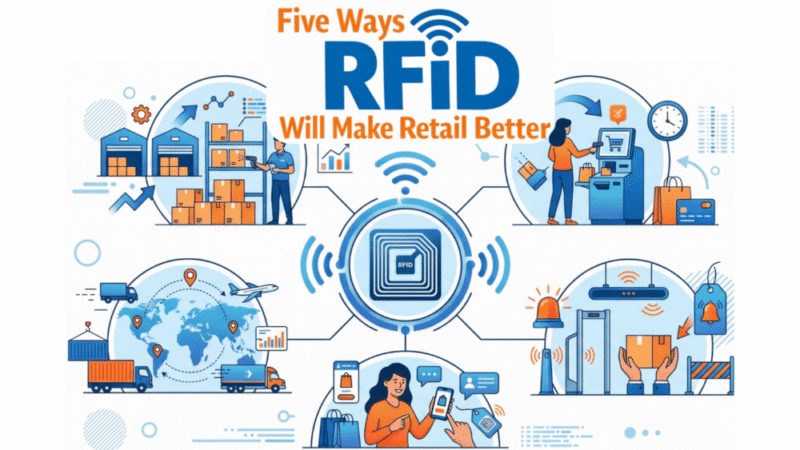
Radio Frequency Identification (RFID) has moved from being a futuristic technology to a practical, game-changing tool in retail. By embedding tiny tags into products, retailers can track, manage, and analyze inventory with unprecedented precision. The impact of RFID goes far beyond stock management—it reshapes customer experience, supply chain efficiency, and profitability. Let’s explore five major ways RFID is revolutionizing retail.
1. Real-Time Inventory Accuracy
- Inventory accuracy is the backbone of retail success. Traditional barcode systems often leave retailers with only 65–75% accuracy, leading to frequent out-of-stock situations and frustrated customers. RFID technology changes the game by providing item-level visibility and boosting accuracy to nearly 98%.
- RFID readers: Unlike barcodes that require line-of-sight scanning, RFID readers can scan hundreds of items simultaneously, dramatically reducing manual effort.
- RFID labels: Each product is equipped with a unique RFID tag, enabling precise tracking across shelves, backrooms, and warehouses.
- RFID software: Real-time synchronization ensures inventory data is updated instantly, minimizing discrepancies and preventing overselling.
Benefits
-
- Automated Scanning: Faster cycle counts and reconciliations with RFID readers.
- Fewer Stockouts: Customers find what they want when they want it, improving trust and loyalty.
- Operational Efficiency: Staff spend less time manually counting and more time serving customers.
This level of precision ensures that retailers know exactly what is on the shelf, in the backroom, and in transit—reducing lost sales and improving customer satisfaction.
2. Enhanced Loss Prevention & Shrinkage Control
Shrinkage—losses due to theft, damage, or misplacement—has long plagued retailers. RFID provides a powerful solution:
- Real-Time Tracking: Every item can be monitored from the supplier to the store floor.
- Theft Deterrence: RFID-enabled gates can detect unpaid items leaving the store.
- Automated Audits: Regular stock checks become faster and more accurate, reducing discrepancies.
By minimizing shrinkage, retailers protect their margins and reduce the hidden costs that erode profitability.
3. Streamlined Checkout & Customer Experience
Long queues at checkout are one of the biggest pain points in retail. RFID offers a path to frictionless shopping:
- Checkout-Free Stores: RFID readers automatically detect items as customers exit, eliminating the need for scanning.
- Faster Transactions: Even in traditional setups, RFID speeds up checkout by scanning multiple items at once.
- Personalized Promotions: RFID data can be linked to loyalty programs, enabling tailored discounts and recommendations.
This creates a seamless, modern shopping experience that mirrors the convenience of online retail, but in a physical store.
4. Smarter Supply Chain & Automated Restocking
RFID doesn’t stop at the store—it transforms the entire supply chain:
- End-to-End Visibility: Retailers can track goods from manufacturing plants to distribution centers to store shelves.
- Automated Replenishment: Systems can trigger restocking orders when inventory drops below a threshold.
- Reduced Errors: Mis-shipments and misplaced items are minimized thanks to precise tracking.
This efficiency lowers operational costs, reduces waste, and ensures that customers always find stocked shelves.
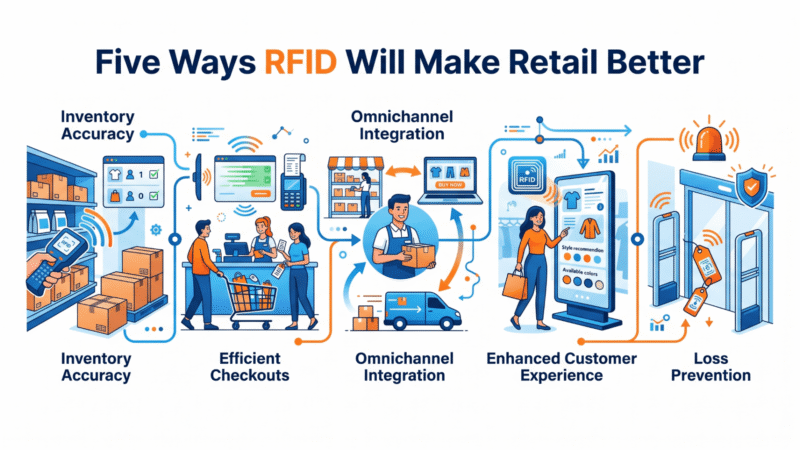
5. Data-Driven Insights & Omnichannel Integration
RFID generates a wealth of data that retailers can harness for strategic advantage:
- Customer Behavior Analysis: Track how long items stay on shelves, which products move fastest, and which linger.
- Store Layout Optimization: Insights into product movement help retailers design layouts that maximize sales.
- Omnichannel Fulfillment: Accurate inventory visibility across online and offline platforms ensures smooth order fulfillment.
In an era where customers expect seamless integration between e-commerce and brick-and-mortar, RFID provides the backbone for true omnichannel retailing.
RFID vs. Barcode: A Clear Advantage for RFID
| Feature | Barcode System | RFID System |
|---|---|---|
| Inventory Accuracy | 65–75% | ~98% |
| Stock Visibility | Batch-level | Item-level |
| Checkout Speed | Manual scan | Automatic |
| Shrinkage Control | Limited | Real-time |
| Data Insights | Minimal | Advanced analytics |
Challenges to Consider
- Implementation Costs: Tags, readers, and infrastructure require upfront investment.
- System Integration: RFID must align with existing ERP and POS systems.
- Environmental Factors: Tags may face interference in high-moisture or metal-heavy environments.
Despite these hurdles, the long-term ROI often outweighs the initial costs.
Conclusion
RFID is not just a technology upgrade—it’s a strategic necessity for modern retail. By delivering real-time inventory accuracy, reducing shrinkage, enabling frictionless checkout, and powering data-driven insights, RFID positions retailers to thrive in a competitive market.
Retailers who embrace RFID today will be tomorrow’s leaders, offering customers the convenience, reliability, and personalization they demand. In fast-growing retail hubs like the USA, Canada, etc., RFID adoption could be the defining factor between lagging and leading the retail revolution.